

RackNerd shared hosting sits at the entry level of a provider better known for servers (logo from racknerd.com)
RackNerd shared hosting starts at USD 5.59 a month for 30 GB of SSD space, cPanel, free SSL and daily off-site backups. RackNerd shared hosting is the cheapest thing the company sells, and it sits in the shadow of the VPS and dedicated server lines the company is better known for.
That makes RackNerd shared hosting worth a close look, because the pricing on these six plans – three shared, three reseller – does not behave the way hosting pricing usually does. Disk per dollar swings by a factor of two inside one product line. The middle reseller plan is cheaper per account than the largest one. And one add-on costs exactly the same whether you pay monthly or yearly.
Every RackNerd shared hosting figure below was read from racknerd.com on 3 November 2026 and the arithmetic was done from the prices RackNerd publishes. If you want the current plan list alongside this review, the RackNerd hosting pages are where the order forms live.
RackNerd shared hosting plans and what each one costs
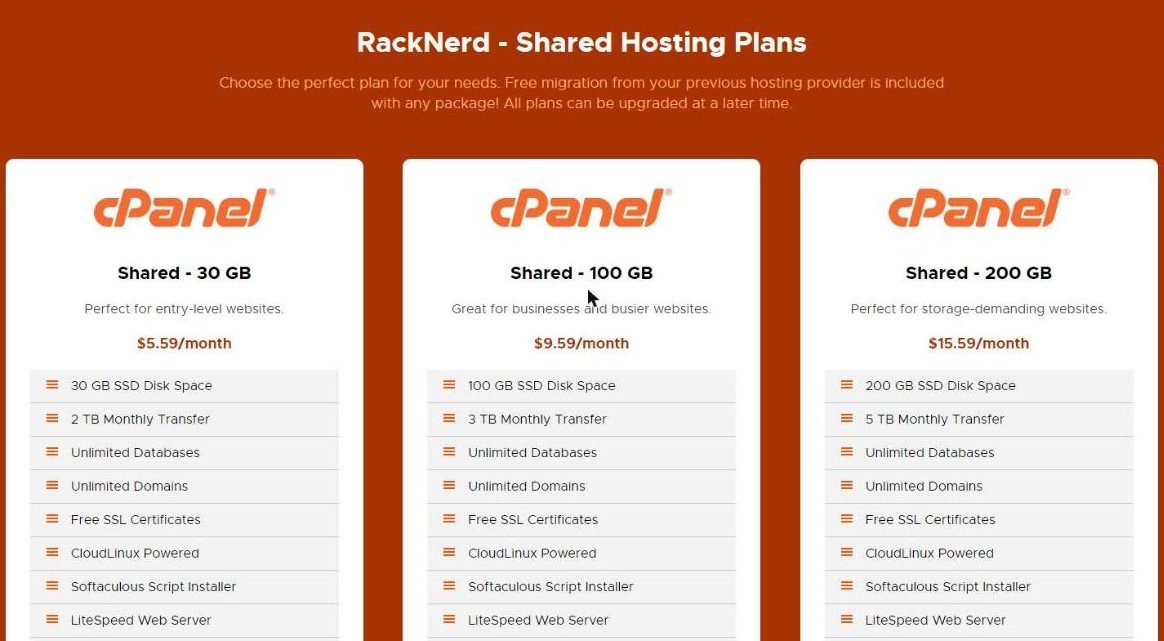
The three shared plans, with the feature list identical across all of them (screenshot from racknerd.com)
| Plan | Price | SSD disk | Monthly transfer | GB per dollar |
|---|---|---|---|---|
| Shared – 30 GB | USD 5.59/mo | 30 GB | 2 TB | 5.37 |
| Shared – 100 GB | USD 9.59/mo | 100 GB | 3 TB | 10.43 |
| Shared – 200 GB | USD 15.59/mo | 200 GB | 5 TB | 12.83 |
Every RackNerd shared hosting plan carries the same feature list, with nothing held back for the more expensive tiers:
- Unlimited databases and unlimited domains on all three
- Free SSL certificates
- CloudLinux for per-account resource isolation
- Softaculous one-click script installer
- LiteSpeed Web Server with LSCache
- Free daily backups via JetBackup
- cPanel control panel
- Deployable in the US, EU and Asia
Free migration from a previous host is included with every package, and RackNerd states that plans can be upgraded later from inside the client area.
RackNerd shared hosting: the entry plan is the worst value per gigabyte
Run the RackNerd shared hosting disk against the price and the curve is steep. The 30 GB plan buys 5.37 GB per dollar. The 100 GB plan buys 10.43. The 200 GB plan buys 12.83. Stepping from the first plan to the second costs USD 4.00 more and returns 70 GB – roughly 17.5 GB for each extra dollar, which is three times the rate the entry plan charges.
Transfer across the RackNerd shared hosting tiers moves the same way but more gently: 2 TB, 3 TB, 5 TB. So the 200 GB plan is 2.8 times the price of the 30 GB plan while carrying 6.7 times the disk and 2.5 times the transfer.
None of this makes the cheap RackNerd shared hosting plan bad – it makes it a small plan priced like a small plan, which is normal in this industry. It is worth knowing before you buy that the second tier is where the value curve actually bends, and that unlimited databases and domains mean a single 30 GB account can host a lot of small sites before space runs out.
The reseller plans, and the cPanel accounts they include
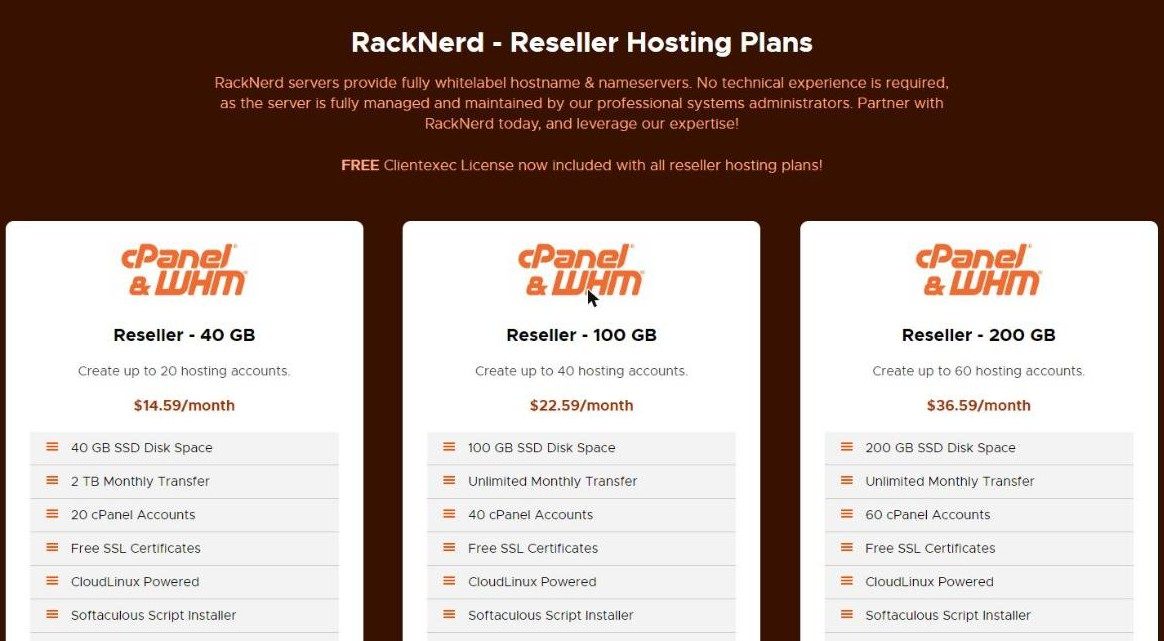
Reseller plans run from 20 to 60 cPanel accounts, with the top two carrying unlimited transfer (screenshot from racknerd.com)
| Plan | Price | SSD disk | Monthly transfer | cPanel accounts |
|---|---|---|---|---|
| Reseller – 40 GB | USD 14.59/mo | 40 GB | 2 TB | 20 |
| Reseller – 100 GB | USD 22.59/mo | 100 GB | Unlimited | 40 |
| Reseller – 200 GB | USD 36.59/mo | 200 GB | Unlimited | 60 |
Reseller plans add cPanel & WHM instead of the cPanel alone that RackNerd shared hosting ships with, fully whitelabel hostname and nameservers, free migrations, and a free Clientexec billing licence. RackNerd describes the servers as fully managed and maintained by its own administrators, with no technical experience required.
One detail in that table is easy to miss. The 40 GB plan is metered at 2 TB, exactly like the entry shared plan – but both larger reseller plans carry unlimited monthly transfer. That is not in the plan headline, which only names disk and account count. For a reseller whose clients run media-heavy sites, moving from the 40 GB plan to the 100 GB plan removes the transfer ceiling entirely, and that may matter more than the extra 60 GB.
The same 100 GB costs 2.36 times more on the reseller side
Put RackNerd shared hosting and the reseller line side by side at the same disk size and the gap is stark. Shared – 100 GB is USD 9.59. Reseller – 100 GB is USD 22.59. Same 100 GB of SSD as RackNerd shared hosting, same CloudLinux, same LiteSpeed, same JetBackup, same Softaculous – and 2.36 times the price.
The USD 13.00 difference buys four specific things, none of which is storage:
- 40 separate cPanel accounts you can create and hand out, instead of one account
- WHM on top of cPanel, which is what lets you create those accounts
- Unlimited monthly transfer in place of the 3 TB cap
- A free Clientexec licence for billing your own customers, plus whitelabel nameservers
If you are hosting your own sites, that is USD 13.00 a month for features you will not use, and RackNerd shared hosting is the obvious buy. If you intend to sell hosting, the Clientexec licence alone is a real line item that RackNerd is absorbing. The decision is binary and it has nothing to do with how much disk you need.
The middle reseller plan is the cheapest per account
Divide each price above RackNerd shared hosting by the number of cPanel accounts it includes and the ranking is not the one you would expect:
| Plan | Price | cPanel accounts | Price per account | Disk per account |
|---|---|---|---|---|
| Reseller – 40 GB | USD 14.59 | 20 | USD 0.73 | 2.0 GB |
| Reseller – 100 GB | USD 22.59 | 40 | USD 0.56 | 2.5 GB |
| Reseller – 200 GB | USD 36.59 | 60 | USD 0.61 | 3.3 GB |
The 100 GB plan is the cheapest per account at USD 0.56 on the reseller plan list, and the largest plan is more expensive per account than the middle one. What the 200 GB plan actually buys is a more generous disk allowance behind each account – 3.3 GB against 2.5 GB – rather than cheaper accounts.
So the question for a reseller is not “how many accounts do I need” but “how big are the sites”. Sixty small WordPress installs fit comfortably on the middle plan. Sixty media-heavy sites do not.
Extra accounts: when to upgrade and when to buy a la carte

RackNerd charges USD 0.50 a month for each extra cPanel account above the plan limit (screenshot from racknerd.com)
RackNerd gives two routes when a reseller account built on the RackNerd shared hosting stack runs out of slots: upgrade to the next plan, or add accounts individually at USD 0.50 per month each. The company does not publish the comparison, so here it is.
| Move | Extra cost per month | Extra accounts | Cost per extra account | Better route |
|---|---|---|---|---|
| Reseller 40 GB → 100 GB | USD 8.00 | +20 | USD 0.40 | Upgrade, past 16 accounts |
| Reseller 100 GB → 200 GB | USD 14.00 | +20 | USD 0.70 | A la carte, under 28 accounts |
The first move is the cheaper one by a clear margin, and it is the one most people stepping up from RackNerd shared hosting will hit first. Upgrading from the 40 GB plan costs USD 8.00 a month, which is what 16 a la carte accounts would cost – so from the seventeenth extra account onwards the upgrade is cheaper, and it throws in 60 GB of disk and unlimited transfer for nothing.
The second move inverts it. Going from the 100 GB plan to the 200 GB plan costs USD 14.00 for 20 more accounts, or USD 0.70 each, while buying them individually costs USD 0.50 each. If you need twenty more accounts and not much more disk, a la carte saves USD 4.00 a month. The upgrade only wins once you also need the extra 100 GB.
The annual option on extra accounts has no discount in it
RackNerd prices an extra cPanel account at USD 0.50 monthly or USD 6.00 annually, billed to match your billing cycle. Twelve months at USD 0.50 is USD 6.00 exactly.
Paying a year up front therefore saves nothing at all on this particular add-on – it is the same money, earlier. That is unusual: annual prepayment normally carries a discount of ten to twenty per cent, which is the whole reason hosts offer it. The honest reading is that this is a convenience option for matching billing dates rather than a saving, and for anyone weighing it up, monthly keeps the money in your account longer for the same outcome.
The main RackNerd shared hosting and reseller plans behave differently – RackNerd says annual prepayment options are available in the order form – so this flat rate applies to the add-on, not to the plans themselves.
RackNerd shared hosting runs in five of twenty datacenters
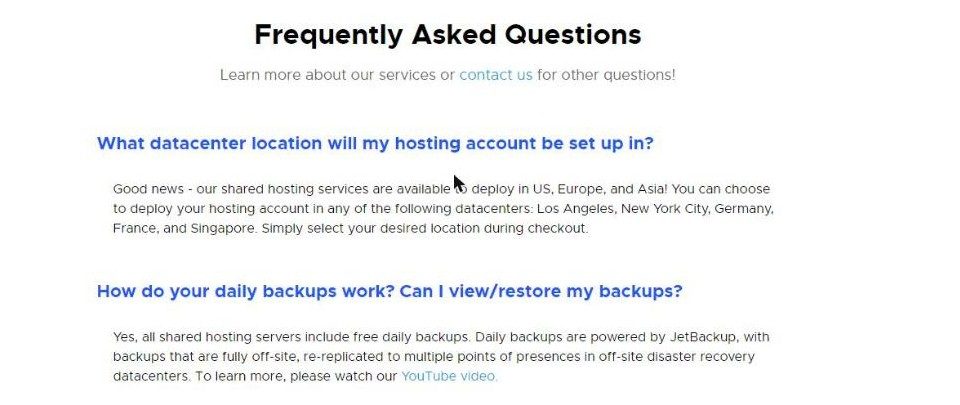
The deployment choices offered during checkout for shared hosting (screenshot from racknerd.com)
RackNerd operates a large network – the datacenters index lists twenty individual facility pages, from Los Angeles and San Jose through Chicago, Dallas, Atlanta, Ashburn, Seattle, Tampa, Miami, New York, New Jersey, Toronto and Montreal to London, Dublin, Amsterdam, Frankfurt, Strasbourg, Utah and Singapore.
RackNerd shared hosting and reseller hosting are not available in all of them. The FAQ on both pages names the same five options:
“You can choose to deploy your hosting account in any of the following datacenters: Los Angeles, New York City, Germany, France, and Singapore.”
That is five of twenty, covering the US east and west coasts, two EU locations and one in Asia – enough for most audiences, but worth checking against where your readers actually are. Note also that the FAQ names countries for the European options while the datacenter index names cities (Frankfurt and Strasbourg), so the specific facility is not stated on the hosting page itself.
One more thing worth flagging so nobody is caught out: the promotional banner across racknerd.com advertises 15% off for life with the code 15OFFDEDI, and the banner text says on all dedicated servers. It does not apply to shared or reseller plans.
What every RackNerd shared hosting plan includes underneath
The six RackNerd shared hosting and reseller plans share a stack that is more current than the prices suggest:
- LiteSpeed Web Server with LSCache – RackNerd names it on both product pages as the performance layer
- CloudLinux – the standard way shared hosts stop one busy account from starving its neighbours
- KernelCare – RackNerd states that kernel updates are applied automatically without a reboot, so security patches do not cost you uptime
- JetBackup daily backups – described as fully off-site and re-replicated to multiple points of presence in disaster-recovery datacenters
- Immediate activation – accounts are usable right after the order goes through
- Month to month, no contract on every plan
The RackNerd shared hosting backup arrangement is the one to pay attention to. Off-site replication is exactly what backup guidance asks for – the US Cybersecurity and Infrastructure Security Agency recommends keeping a copy of your data away from your primary location as part of the 3-2-1 rule. A host that does this by default, at USD 5.59 a month, is covering a step most small sites never get round to.
That said, a host-run backup is the host’s copy. If the account itself is lost, closed or disputed, the backup is inside the same relationship. A periodic download of your own is the cheap insurance.
The RackNerd shared hosting SLA: five nines, and 180 excluded minutes
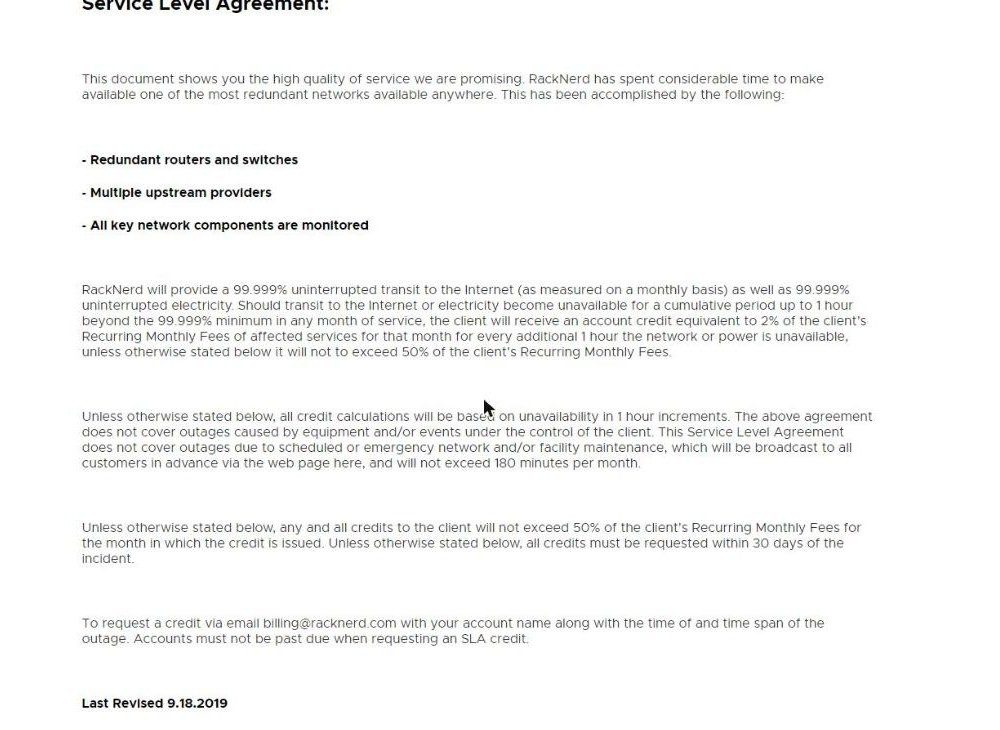
The full RackNerd service level agreement, last revised in September 2019 (screenshot from racknerd.com)
For RackNerd shared hosting, as for every other service, RackNerd commits to 99.999% uninterrupted transit and 99.999% uninterrupted electricity, measured monthly. On a 30-day month, 99.999% works out at about 26 seconds of allowable downtime.
The same document also states that the agreement does not cover scheduled or emergency maintenance, which is broadcast in advance and “will not exceed 180 minutes per month”. Both numbers are in the SLA, and they describe different things: the first is the uptime target for unplanned failure, the second is the ceiling on planned work that sits outside the target. Taken together, the floor the contract actually guarantees on a 30-day month is closer to 99.58% than to 99.999%. A reader can check that in one line: 43,200 minutes minus 180 is 43,020, and 43,020 divided by 43,200 is 0.9958.
The remedy side is specific too. Credits run at 2% of your recurring monthly fee for each additional hour of outage beyond the first, calculated in whole-hour increments, and capped at 50% of the monthly fee. On a USD 5.59 plan, each qualifying hour is about 11 cents and the maximum possible credit in any month is about USD 2.80 against the entry plan price – and reaching that cap would take roughly 25 hours of downtime. Credits must be requested by email within 30 days, and the account must not be past due.
The page carries a “Last Revised 9.18.2019” line, so these terms have been stable for some years.
RackNerd shared hosting billing terms worth reading first
Three things in the RackNerd shared hosting terms are worth knowing up front, and they interact.
First, every RackNerd shared hosting plan is month to month with no contract, and annual prepayment is offered in the order form if you want it. Second, the terms of service state that “by default no refunds are provided once payment is received”, with refunds handled case by case because provisioning carries real cost; the same passage says RackNerd intends to work with clients fairly and will explain what is possible. Third, data on cancelled or terminated services is deleted immediately.
Put together, those produce a clear piece of practical advice rather than a warning. Paying monthly caps your exposure at one month – USD 5.59 on the entry plan – which is a small amount to risk on finding out whether a host suits you. Take the annual option after you are satisfied, not before. And because cancelled accounts are wiped straight away, pull your own copy of the files and databases before you close anything.
Migration help is free on RackNerd shared hosting and on the reseller line, with one difference between them: the shared hosting FAQ offers migration from your existing provider, while the reseller FAQ adds the condition “as long as they are using cPanel control panel”. Reseller migrations are account-to-account transfers, so the source panel has to match.
Who RackNerd shared hosting fits
It fits someone running one site or a handful of small ones who wants cPanel, free SSL, LiteSpeed and daily off-site backups without paying a premium brand price – and who is comfortable choosing from five locations. The unlimited domains and databases on every tier mean the entry plan stretches a lot further than 30 GB sounds.
The reseller tier above RackNerd shared hosting fits a freelancer or small agency already managing client sites, where the free Clientexec licence, WHM and whitelabel nameservers turn hosting into a line of business. The 100 GB plan is the sweet spot on both price per account and the jump to unlimited transfer.
RackNerd shared hosting fits less well if you need a datacenter outside those five, if you want a managed WordPress stack with staging and object caching built in, if your sites need root access or custom server software – RackNerd’s own VPS line is the answer there – or if you want a money-back guarantee as a safety net, since refunds are discretionary rather than automatic.
How this review was done
This RackNerd shared hosting review is a desk review. Nobody on this site bought, provisioned or benchmarked a RackNerd account, and nothing above describes hands-on performance. Every figure was read from racknerd.com on 3 November 2026: the shared hosting page, the reseller hosting page and both FAQ sections, the datacenters index, the service level agreement and the terms of service.
All RackNerd shared hosting prices are the monthly rates RackNerd publishes in US dollars. The derived numbers – GB per dollar, price per cPanel account, the upgrade break-evens, the 99.58% figure and the credit amounts – were calculated from those published prices and are shown with their workings so they can be checked. Where RackNerd states something about its own service, it is reported as the company’s statement. No uptime or speed claim is made here that RackNerd did not publish itself.
The short version
RackNerd shared hosting is a cheap, well-equipped entry tier: cPanel, LiteSpeed with LSCache, CloudLinux, KernelCare, free SSL and off-site JetBackup from USD 5.59 a month, with unlimited domains and databases on every plan and no contract. The reseller line adds WHM, whitelabel nameservers and a free Clientexec licence from USD 14.59.
The RackNerd shared hosting numbers reward a few minutes of arithmetic. The second shared tier is where value per gigabyte roughly doubles. The middle reseller plan is the cheapest per account, not the biggest one. Extra accounts cost the same annually as monthly. And the SLA’s five nines sit alongside a 180-minute maintenance exclusion that is worth reading in the same breath.
Overall: 8.5 / 10. Points come off RackNerd shared hosting for the discretionary refund policy and the narrow five-location footprint, not for the specification, which is generous at these prices. Current plans and order forms are on the official RackNerd hosting pages.