

Buddha3Bodhi sells Himalayan-inspired beads and crafts directly at buddha3bodhi.com (screenshot from buddha3bodhi.com).
Dzi beads are one of the most recognisable things in Himalayan bead culture, and also one of the hardest to shop for cold: the patterns have names, the sizes are quoted in millimetres, and the word “Tibetan” does a lot of work in product titles. This guide walks through the Buddha3Bodhi Dzi beads range exactly as the shop publishes it – 54 listings, their patterns, their bead sizes, their price spread and the wording in their spec boxes – so you know what you are choosing between before you choose.
Everything below was read off Buddha3Bodhi’s own public pages and storefront data on 2 November 2026. Nothing here is a claim about authenticity or spiritual effect; it is a map of what the Buddha3Bodhi Dzi beads listings say about themselves. If you want to browse along, the shop is here.
How this review was done
This is a desk review. No bead was bought, handled or appraised. Every figure comes from Buddha3Bodhi’s public storefront data and policy pages, read on 2 November 2026: the collection listing, the shop’s own product feed, two full product pages, the FAQ, the Return Policy page and the Refund Policy page. Where the shop says something, this guide says so. Where two of its pages differ, both versions are printed rather than averaged, and no judgement is made about which is correct.
One thing this guide deliberately does not do is rule on authenticity. Dzi grading is a specialist field, and nothing about a web listing – here or anywhere – can settle it. What a careful reader can do is compare the shop’s own words across its own pages, and that is what the Buddha3Bodhi Dzi beads notes below are.
Where the Buddha3Bodhi Dzi beads sit in the catalogue

The Dzi range lives under Tibetan Collection, one of six top-level groups (screenshot from buddha3bodhi.com).
Scale first, because it changes how you read everything else. Buddha3Bodhi publishes 59 collections, and its catch-all “All Product” collection reports 1,446 products. This is a broad Himalayan-craft store, not a Dzi specialist, and the Buddha3Bodhi Dzi beads range is one shelf inside it rather than the whole business.
The navigation makes that structure explicit. Six groups sit at the top – Bodhi, Jade, Tibetan, Crystal, Symbol and Meditation – and the Tibetan Collection opens onto five shelves: Red String, Tibetan Bracelets, Tibetan Crystal Artistry, Tibetan Bone Jewelry and Tibetan Dzi Beads. For context, the neighbouring shelves are far larger: Wenwan Walnuts carries 216 listings, Bodhi Bracelets 232 and Crystal DIY 218. The Buddha3Bodhi Dzi beads shelf is deliberately small by comparison.
| Collection | Listings the shop reports |
|---|---|
| All Product | 1,446 |
| Bodhi Bracelets | 232 |
| Wenwan Walnuts | 216 |
| Crystal DIY Series | 218 |
| Natural Premium Jade | 174 |
| Incense Burners | 151 |
| Tibetan Dzi Beads | 55 in the menu data, 54 on the page |
What the Buddha3Bodhi Dzi beads collection actually holds
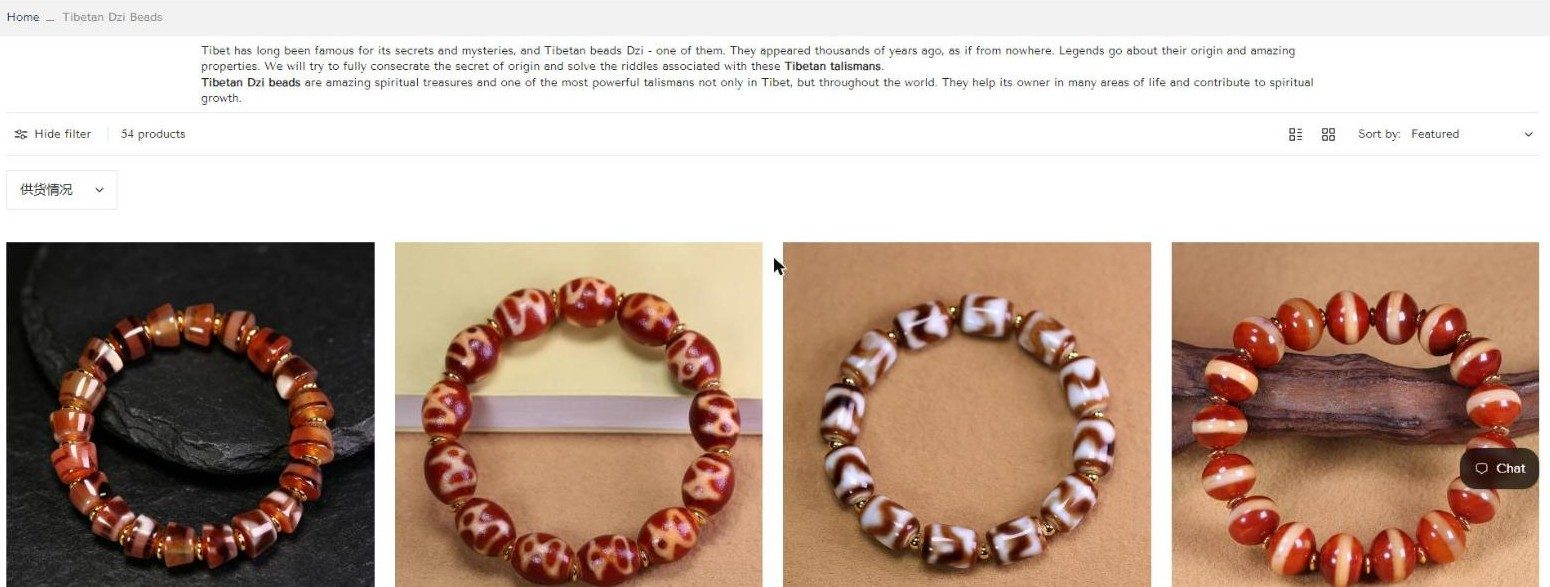
The collection page prints its own count above the grid (screenshot from buddha3bodhi.com).
Here is the first small thing worth noticing, and it takes ten seconds to check. The shop’s collection data reports 55 products in Tibetan Dzi Beads; the collection page itself prints “54 products” above the grid, and the product feed returns 54. The likeliest reading is one listing hidden or out of stock, and it changes nothing for a buyer – but it is the kind of one-off mismatch that tells you the Buddha3Bodhi Dzi beads counts are generated rather than hand-typed.
Across those 54 Buddha3Bodhi Dzi beads listings there are 88 variants, because 14 products offer more than one option – usually a size or a bead count. Every listing carries Buddha3Bodhi’s own vendor name rather than a third-party supplier’s, and 35 of the 54 have the product type field filled in as “Tibetan Dzi Beads” while 19 leave it blank. Again: harmless, and a sign the catalogue has grown in batches rather than in one upload of Buddha3Bodhi Dzi beads.
The collection also opens with a short editorial note rather than a bare grid. It describes Dzi as beads that “appeared thousands of years ago, as if from nowhere” and calls them Tibetan talismans – framing the range as cultural objects, which matches how the individual Buddha3Bodhi Dzi beads pages are written.
Tibetan or Tibetan-Style? Read the spec box
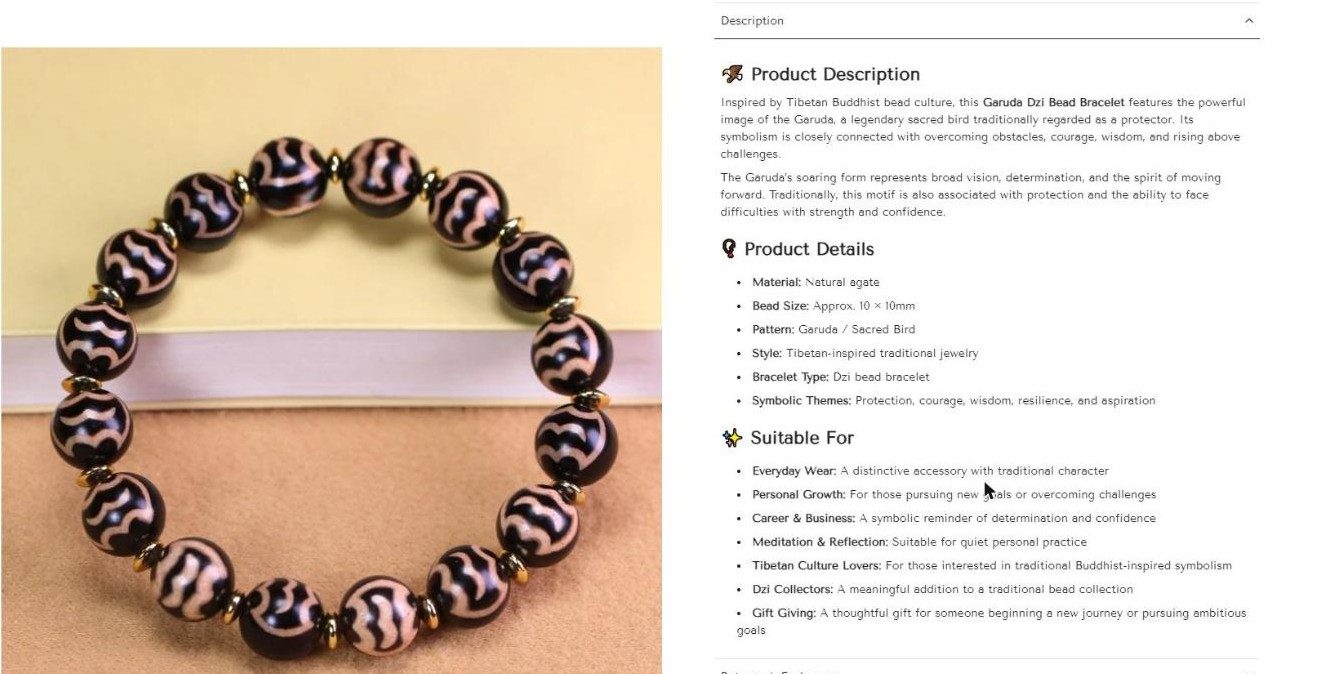
A listing whose title says “Tibetan-Style”, with its own Product Details block (screenshot from buddha3bodhi.com).
This is the single most useful thing to know before buying Buddha3Bodhi Dzi beads, and it is a credit to the shop that you can find it without asking anyone. Among the 54 titles, 40 say simply “Tibetan” and 4 say “Tibetan-Style”. In this market those are not the same claim, so a shopper reading titles alone could reasonably assume the first group is making a stronger one.
Open the spec boxes and the picture resolves. On a listing titled Natural Tibetan Agate Tiger Tooth Dzi Bead Bracelet, the Product Details block lists Style: Tibetan-inspired traditional jewelry. On a listing titled Natural Tibetan-Style Garuda Dzi Bead Bracelet, the same field reads Style: Tibetan-inspired traditional jewelry – word for word. The body copy matches: the first says its pattern is “inspired by traditional Tibetan bead culture”, the second opens “Inspired by Tibetan Buddhist bead culture”.
So the consistent, published position across the Buddha3Bodhi Dzi beads range is Tibetan-inspired, whatever the title shortens to. That is a clear answer, printed on every product page, and it is the answer to carry into any Buddha3Bodhi Dzi beads purchase. It also means the spec box – not the title – is the field to read first.
The Buddha3Bodhi Dzi beads patterns, and what the listings say they mean
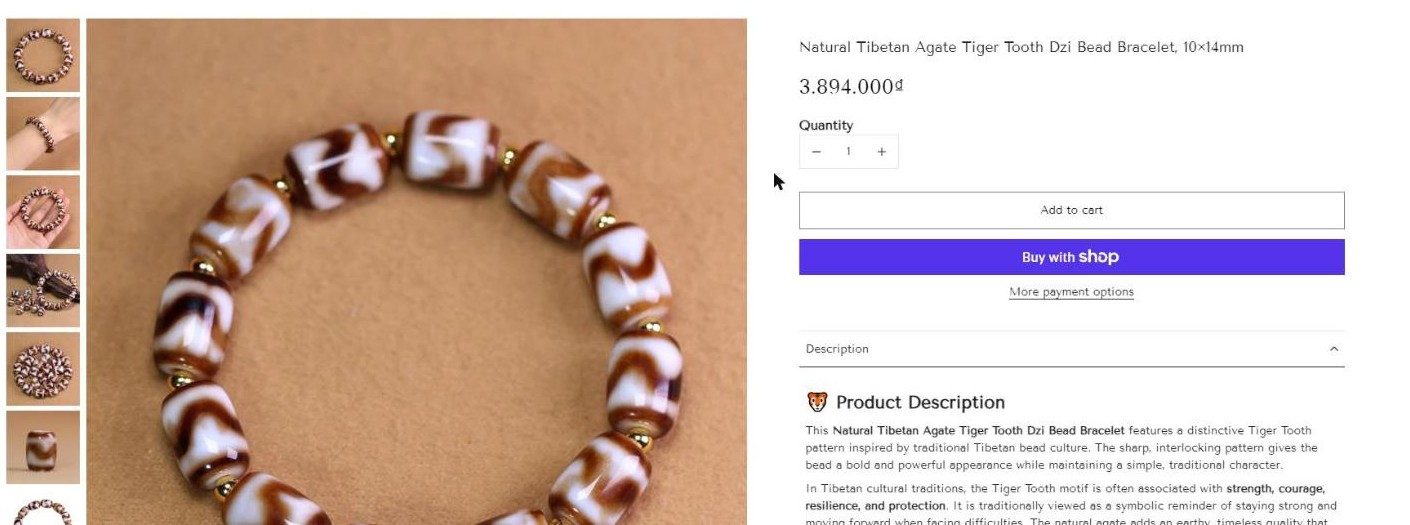
Each listing opens with a large gallery and the pattern named in the title (screenshot from buddha3bodhi.com).
Dzi are sold by pattern, and the Buddha3Bodhi Dzi beads listings name the pattern in the title and again in the spec box. Across the 54 Buddha3Bodhi Dzi beads listings the recurring motifs are easy to count:
| Pattern named in the title | Listings | What the shop says it stands for |
|---|---|---|
| Tiger Tooth | 9 | “strength, courage, resilience, and protection” |
| Three-Eye | 2 | often paired with Tiger Tooth in the same listing |
| One-Line | 3 | the plainest band pattern in the range |
| Medicine Buddha | 2 | sold both as bracelets and as a 108-bead mala |
| Garuda / Sacred Bird | 1 | “Protection, courage, wisdom, resilience, and aspiration” |
| Dalu Treasure Vase | 1 | the most expensive single listing in the shelf |
| Other named patterns | the rest | listed individually per product |
The wording around meaning is careful, and worth repeating accurately: these are the shop’s descriptions of traditional symbolism, not claims about what a bead will do. A typical line reads “In Tibetan cultural traditions, the Tiger Tooth motif is often associated with strength, courage, resilience, and protection” and calls it “a symbolic reminder”. Read the Buddha3Bodhi Dzi beads pages that way and they are informative; read them as promises and you are reading something that is not there.
Materials behind the Buddha3Bodhi Dzi beads
Nineteen of the 54 titles name agate, one names chalcedony, and four use the word aged – as in “Aged Mine Red Agate”. The spec boxes repeat it in a dedicated Material field: “Natural Tibetan agate” on one listing, “Natural agate” on another. For anyone new to the category, agate is a banded variety of chalcedony, itself a microcrystalline form of quartz, which is why the two words show up side by side in the same shelf. The Gemological Institute of America’s note on chalcedony is a good plain-English starting point if you want the mineralogy before you shop.
What that means practically for Buddha3Bodhi Dzi beads is that the banding you are buying is a natural feature of the stone, and the finish is a workshop decision. Every spec box in the range ends with the same two fields – Shape and Finish – typically “Oval / rounded bead” and “Smooth polished surface”. Two fields, filled in the same way on every listing, which makes comparing two Buddha3Bodhi Dzi beads pages genuinely quick.
Bead size is the number that decides Buddha3Bodhi Dzi beads fit
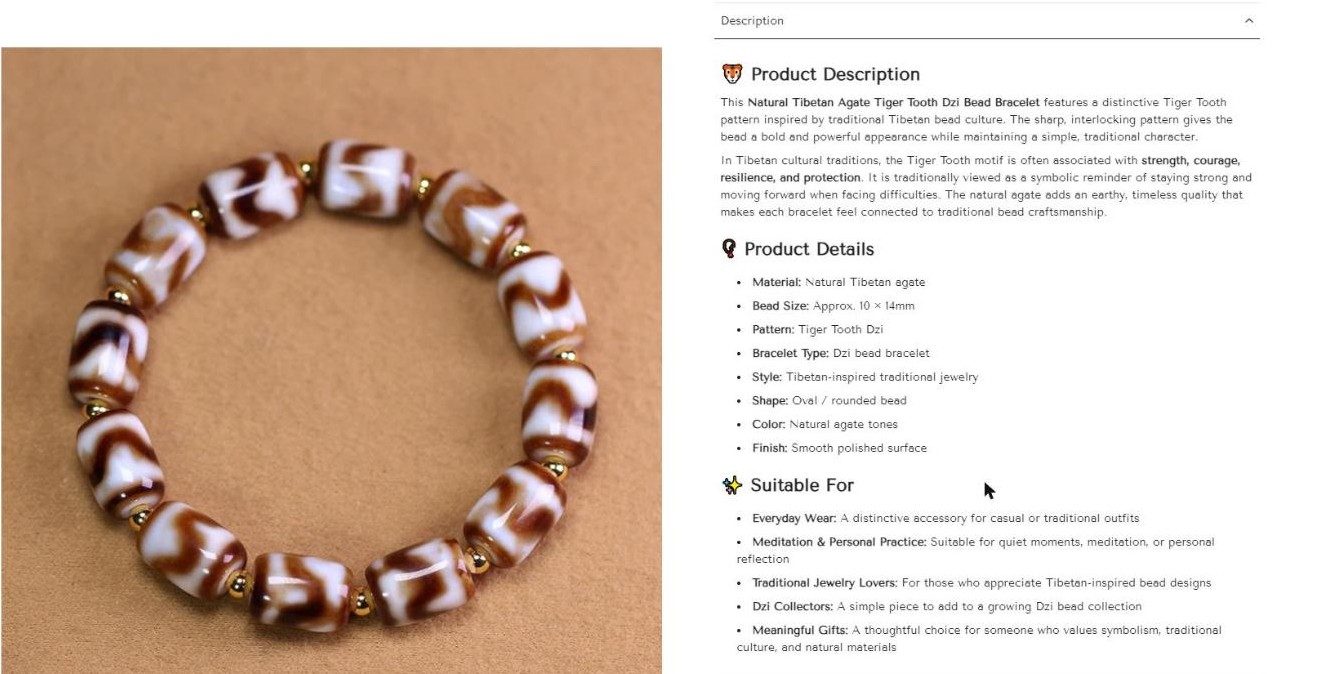
The Product Details block is identical in structure on every listing (screenshot from buddha3bodhi.com).
Every Buddha3Bodhi Dzi beads listing quotes its bead size in millimetres, as two numbers, and that is the field that decides whether a bracelet looks restrained or substantial on a given wrist. The sizes in this shelf run from 7 x 12 mm up to 15 x 18 mm, with 10 x 10, 10 x 11, 10 x 14, 12 x 13 and 14 x 14 mm all appearing.
- 7-10 mm – the discreet end; reads as a bead bracelet rather than a statement piece.
- 10-12 mm – the middle of the shelf, and where most of the Tiger Tooth listings sit.
- 14-18 mm – large beads, fewer to a strand, and noticeably heavier on the wrist.
- 108-bead strands – a different object entirely: a mala meant to be looped, not a bracelet.
Because the size is quoted the same way everywhere, two Buddha3Bodhi Dzi beads listings can be compared in about five seconds. Measure your wrist once before browsing and the 54 listings sort themselves into about three groups, and the full shelf is on the store if you want to measure against it.
What the Buddha3Bodhi Dzi beads cost – and which currency you are seeing
A practical warning before any number: Buddha3Bodhi prices by region. The shop’s own metadata lists its store currency as USD, its announcement bar advertises free shipping over $99, yet a visitor browsing from Vietnam sees every price in dong with a “Vietnam (VND)” selector in the header. So the figure on your screen depends on where you open the page, and the sensible way to compare Buddha3Bodhi Dzi beads is by ratio rather than by converting in your head.
Read as ratios, the shelf is wide. The cheapest Buddha3Bodhi Dzi beads variant and the most expensive differ by a factor of 8.1. The middle of the range sits a little above the midpoint of that span, which tells you the shelf is weighted toward the affordable half with a few high-value pieces pulling the top end.
| Position in the shelf | Relative to the cheapest variant |
|---|---|
| Cheapest variant | 1.0x |
| Lower quarter | about 1.8x |
| Middle | about 2.8x |
| Upper quarter | about 3.4x |
| Most expensive variant | 8.1x |
In plain terms: the entry point to the Buddha3Bodhi Dzi beads shelf is genuinely an entry point, and you would have to move to the top handful of listings – the big 14 mm and 15 x 18 mm pieces, and the Dalu Treasure Vase – before the price multiplies. Checking the actual figure in your own currency at checkout is a thirty-second job and worth doing, since the displayed currency is set for you rather than by you.
On this shelf, sale is the default state
Here is the finding that most changes how you read the Buddha3Bodhi Dzi beads grid. Of the 88 variants in the shelf, 74 – roughly 84 per cent – carry a compare-at price, meaning they display as reduced. The discounts are not token either: they run from 30.3 per cent at the shallow end to 71.8 per cent at the deepest.
They also cluster rather than scatter, which is the giveaway that they are applied in batches rather than struck one bead at a time: 13 variants sit at about 55.8 per cent off, 9 at about 43.5 per cent and 6 at about 47.2 per cent. Add the storefront’s standing BODHI code for a further 10 per cent and the headline figures on the Buddha3Bodhi Dzi beads pages are best treated as a list price that is rarely what anyone pays.
| Discount band | Variants in it |
|---|---|
| About 30-35 per cent off | 11 |
| About 40-48 per cent off | 26 |
| About 49-57 per cent off | 24 |
| About 70-72 per cent off | 3 |
| No compare-at price shown | 14 |
| Total variants | 88 |
None of this is hidden – the compare-at figures are right there on every card – and a shop that discounts broadly is not a shop doing anything unusual. It simply means that “on sale” carries no information when you are choosing between two Buddha3Bodhi Dzi beads listings. Compare the actual prices, not the struck-through ones.
Who makes them, and where the shop is registered
Buddha3Bodhi is direct about both. Its FAQ describes the business as “an independent brand focused on cultural collectible craftsmanship inspired by Himalayan traditions” and says “most of our pieces are handmade or hand-finished by artisans in Tibet, Nepal, and surrounding Himalayan regions”, produced “in collaboration with artisan communities across Tibet, Nepal, and Newari craft regions”.
It also sets expectations about variation rather than glossing over it: “Each piece is individually crafted or selected, so slight variations may occur… natural materials and handmade processes mean every item is unique.” For a natural-stone product that is the honest framing, and it is the right expectation to carry into a Buddha3Bodhi Dzi beads order – the bead you receive will be the pattern you chose, not a pixel-match of the photograph.
On the corporate side, the shop’s own storefront metadata lists Buddha3bodhi in London, England, with a store currency of USD and shipping enabled to most countries. The listings for Buddha3Bodhi Dzi beads also surface a short “Giving Back” note stating that the business supports temple repairs and offers prayers for customers. That is a company statement, published on the product page, and reported here as such.
Shipping, duties and the 30-day window
The FAQ is specific where it matters. Orders are “typically processed and shipped within 1-3 business days”, delivery “typically takes 5-14 business days after dispatch”, all orders include tracking, and delivery time is counted from dispatch rather than from checkout. The shop ships worldwide to most countries, and says plainly that customs duties or taxes may apply depending on destination.
| Stage | What Buddha3Bodhi states |
|---|---|
| Processing | 1-3 business days |
| Delivery after dispatch | 5-14 business days |
| Tracking | Included on all orders |
| Free shipping threshold | Advertised at 99 dollars in the announcement bar |
| Customs and duties | May apply, depending on destination |
| Return window | 30 days from receipt |
| Extended warranty | 1 year, available to purchase separately |
Add those together and a Buddha3Bodhi Dzi beads order placed today is a two-to-three week proposition for most destinations – worth knowing if you are buying for a date. The 30-day return window runs from receipt, not from order, which is the buyer-friendly version of that clock.
Returning Buddha3Bodhi Dzi beads: three pages, three versions of who pays

The returns note that appears on the product page itself (screenshot from buddha3bodhi.com).
All three of Buddha3Bodhi’s return texts agree on the headline – 30 days from receipt, refund or exchange – and the Return Policy page goes further, offering a “30 Day Satisfaction Guarantee” that covers simply changing your mind. Where they differ is on who pays the return postage, and it is worth reading all three before you need them.
| Where it appears | What it says about return shipping |
|---|---|
| Product page accordion | “return the item to us within 30 days for a full refund or exchange. We will handle the rest.” |
| Return Policy page | “Yes, you need to cover shipment if you wish to return an item to us.” |
| Refund Policy page | Customer covers return shipping “unless the item received is defective, damaged upon arrival, or incorrect.” |
The Refund Policy version is the most detailed and the most generous in the case that matters most – a damaged or wrong item – while the product-page wording is the breeziest. They are not irreconcilable, but they are three different sentences about the same question, so for a Buddha3Bodhi Dzi beads return it is worth getting the answer in writing from the shop first. The mechanics are clearly set out either way: email sales@buddha3bodhi.com, expect the return address within 24-48 hours, keep the item unused and ideally unopened, use a tracked service, and the refund follows 1-2 days after the parcel arrives (card refunds can take up to five working days to land).
Who the Buddha3Bodhi Dzi beads fit
A good fit if you want a Tibetan-inspired bead bracelet with the pattern, material and bead size printed in the same place on every listing; if you like being able to compare 54 products in a few minutes because the spec boxes are identically structured; if the symbolism interests you as culture rather than as a promise; and if a two-to-three week international delivery with tracking and a 30-day return window suits how you buy.
Worth a second thought if you are shopping for a graded or certified collector-grade Dzi, because this shelf is described throughout as Tibetan-inspired rather than antique; if you need an exact visual match to the photograph, since the shop says every piece varies; if you want the price in your own currency before checkout, because the storefront picks the currency for you; or if you want return postage settled in advance, in which case ask before ordering.
None of those are faults in the Buddha3Bodhi Dzi beads range – they are the shape of it, and the shop publishes enough detail for you to work all of them out before you spend anything. Browsing the full shelf is the fastest way to see where you land: it is on the Buddha3Bodhi store.
The short version
Buddha3Bodhi runs a wide Himalayan-craft catalogue – 59 collections and 1,446 products – and the Dzi shelf is a deliberately compact 54 listings inside it. The listings are unusually easy to compare because every one of them carries the same spec structure: material, bead size in millimetres, pattern, bracelet type, style, shape and finish.
The things to know before ordering are small and checkable. The range describes itself as Tibetan-inspired in every spec box, whatever the title says. Prices display in the currency of wherever you open the page even though the store currency is USD, so compare by ratio and verify at checkout. Roughly 84 per cent of variants show as discounted, which makes “on sale” a weak signal on this shelf. And three different pages describe return postage three different ways, so get that answer in writing first.
Overall: 8.1 / 10 – a well-documented, easy-to-compare Buddha3Bodhi Dzi beads shelf with honest wording about inspiration, craftsmanship and natural variation, held just short of top marks by region-set pricing and by return-shipping terms that read differently on three of the shop’s own pages. The current range, with live prices in your own region, is on the Buddha3Bodhi store.