
How this review was done. This is a desk review. Every number below was read directly from FITCAMX product pages on 26 October 2026 with the store set to US dollars, and every claim is attributed to the page it came from. No unit was bought, fitted to a car or driven, and nothing here is presented as a road test.
FITCAMX sells a dash cam that is built for one car at a time. Instead of a suction mount on the windscreen, the camera is a vehicle-specific module that sits behind the rear-view mirror and draws power from the car itself, which is why the catalogue is organised by make and model rather than by product. That design choice shapes everything about the FITCAMX dash cam specs and the range they describe, and it is the reason the FITCAMX dash cam specs are worth reading carefully before you pick a configuration: on this brand the box you choose is the box you keep.

FITCAMX brand wordmark (screenshot from fitcamx.com)
This review works through the published FITCAMX dash cam specs for the standard 4K line, the prices attached to each configuration, and the separate STARVIS 2 line that sits above it. Where the company publishes two things that pull in different directions, both are quoted and neither is smoothed over.
What the FITCAMX dash cam specs cover across the range
FITCAMX publishes one table of FITCAMX dash cam specs that applies across the catalogue, and it has three columns rather than three product names: 4K Front Only, 2K Dual Cam and 4K Dual Cam. Whichever car page you open, the configuration picker offers the same three choices, and the table tells you what each one records. That consistency is the most useful thing about the published FITCAMX dash cam specs, because it means a buyer comparing a Toyota page against a Porsche page is comparing the same three cameras.
What changes between car pages is not the FITCAMX dash cam specs but the Model list and the price. The Toyota page carries roughly twenty fitment entries spanning RAV4, Tacoma, Corolla, C-HR, Camry, Highlander, Tundra, 4Runner, Sienna and Prius, each with a year range. The Porsche page carries three: Model A for 992, 971, 9YA, 9Y0, 9Y3 and Taycan, Model B for 95B, 970 and 958, and Model C for 981, 987, 982 and 991. Picking the wrong entry is the one mistake the configuration picker cannot undo for you, so the fitment line matters more here than on a universal dash cam.
The three FITCAMX dash cam specs configurations, and what each costs
On the Toyota page, which carries 456 reviews at the time of writing, the FITCAMX dash cam specs ladder runs as follows. These are the prices the page shows with the store set to US dollars, struck-through list price first and sale price second.
| Configuration | List | Sale | Step over the tier below |
|---|---|---|---|
| Front: 4K (2160P) 64GB | $189.00 | $168.00 | — |
| Front 1440P + Rear 1080P + 64G | $229.00 | $198.00 | +$30 |
| Front 4K + Rear 1080P + 128G | $288.00 | $248.00 | +$50 |
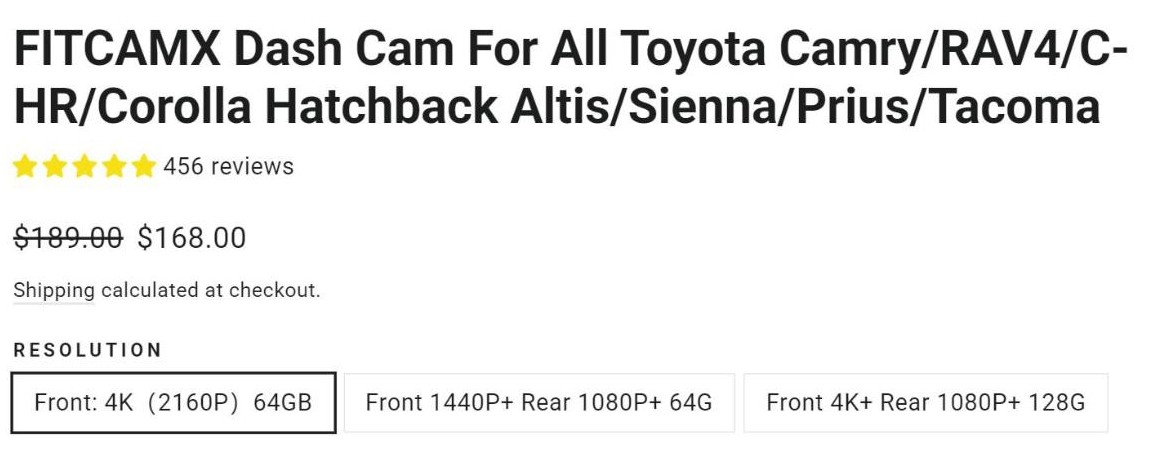
The Toyota page with the entry configuration selected at $168 (screenshot from fitcamx.com)
Two details in that block are easy to miss. The first is the line printed under the picker: “The rear camera cannot be added separately.” The second is that the three sets of FITCAMX dash cam specs are not a simple quality ladder. The middle one is cheaper than the top one because it gives something up, and the FITCAMX dash cam specs say exactly what.
FITCAMX dash cam specs: the trade hidden in the middle tier
Read the FITCAMX dash cam specs table and the middle column stops looking like a straightforward upgrade. The 2K Dual Cam records the front at 1440P, not 2160P. The entry configuration at $168 records the front at 2160P. So moving from the cheapest box to the $198 box buys you a rear camera and costs you front resolution. Only the top configuration at $248 gives you both 4K at the front and a rear camera.
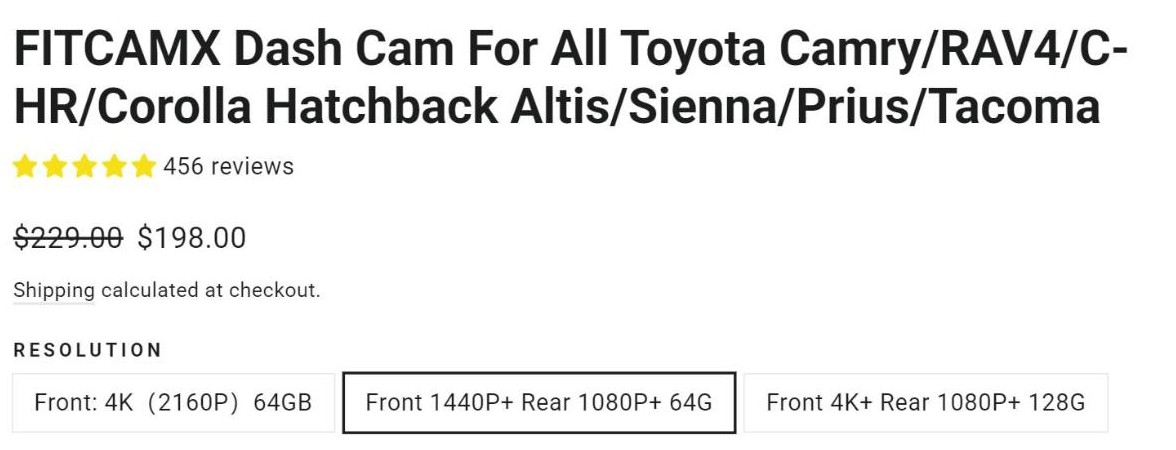
Selecting the 1440P front plus 1080P rear configuration moves the price to $198 (screenshot from fitcamx.com)
That is not hidden – it is written plainly in the option name and in the FITCAMX dash cam specs – but it is the opposite of how most dash cam ranges are laid out, where the middle option is strictly better than the cheap one. On this brand the question is not “how much do I want to spend” but “which do I care about more, the sharpest possible front recording or having a rear camera at all”. If the answer is both, the published FITCAMX dash cam specs route you straight to the top tier.
The full FITCAMX dash cam specs table, row by row
Here are the published FITCAMX dash cam specs exactly as they appear on the product pages. It is the single best reference for the range, and it is worth reading before the marketing copy.
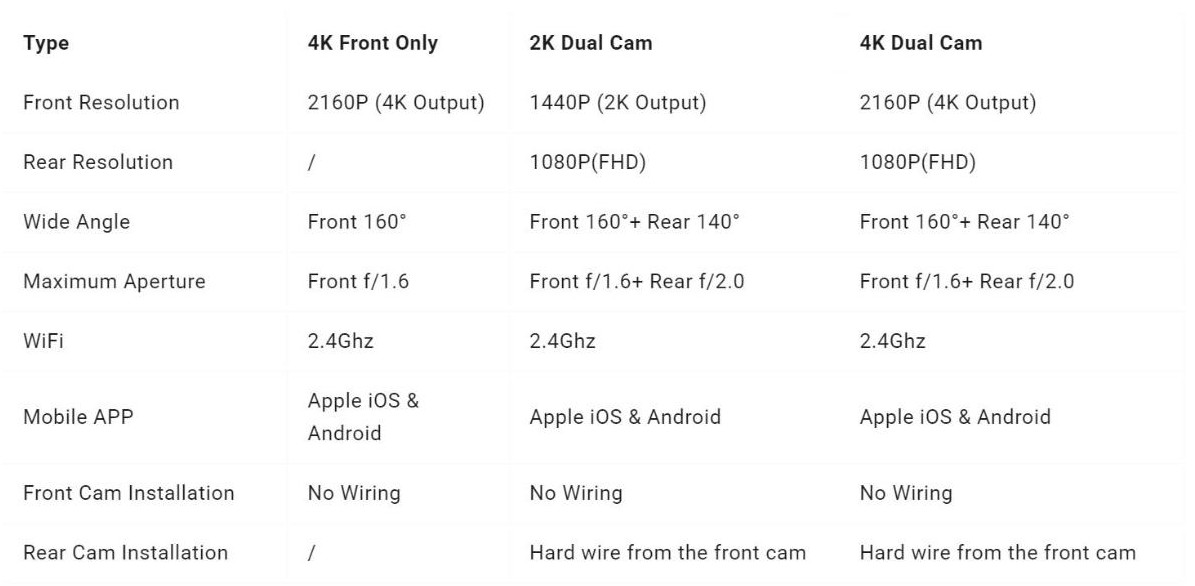
Published comparison table, part one (screenshot from fitcamx.com)
| Row | 4K Front Only | 2K Dual Cam | 4K Dual Cam |
|---|---|---|---|
| Front resolution | 2160P (4K output) | 1440P (2K output) | 2160P (4K output) |
| Rear resolution | none | 1080P (FHD) | 1080P (FHD) |
| Wide angle | Front 160 degrees | Front 160 + rear 140 | Front 160 + rear 140 |
| Maximum aperture | Front f/1.6 | Front f/1.6 + rear f/2.0 | Front f/1.6 + rear f/2.0 |
| WiFi | 2.4GHz | 2.4GHz | 2.4GHz |
| Mobile app | Apple iOS and Android | Apple iOS and Android | Apple iOS and Android |
| Front cam installation | No wiring | No wiring | No wiring |
| Rear cam installation | none | Hard wire from the front cam | Hard wire from the front cam |
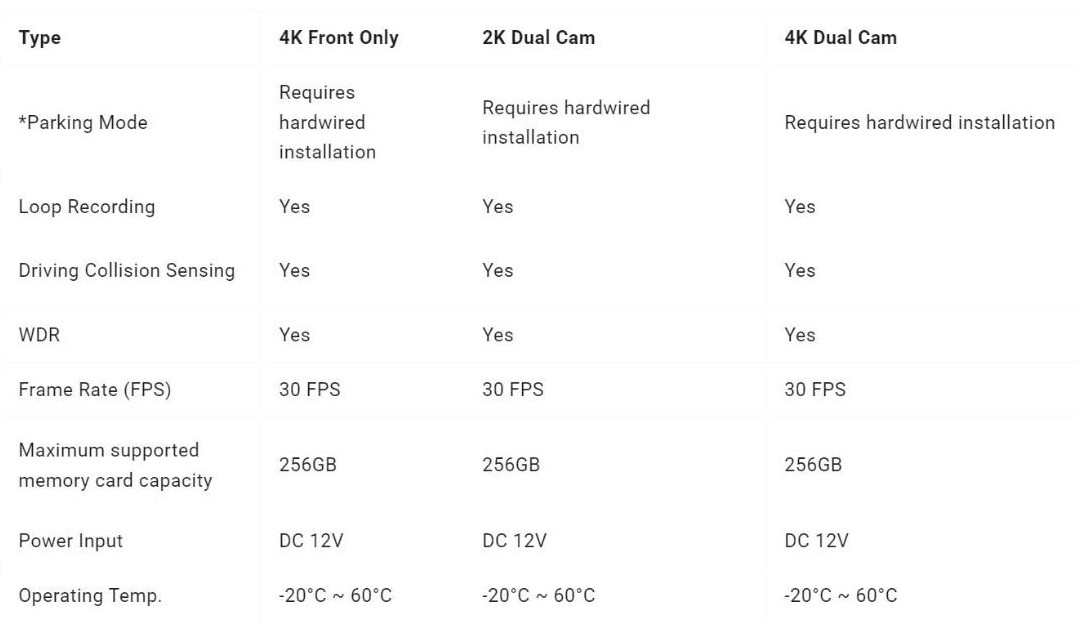
Published comparison table, part two (screenshot from fitcamx.com)
| Row | All three configurations |
|---|---|
| Parking mode | Requires hardwired installation |
| Loop recording | Yes |
| Driving collision sensing | Yes |
| WDR | Yes |
| Frame rate | 30 FPS |
| Maximum supported memory card | 256GB |
| Power input | DC 12V |
| Operating temperature | -20C to 60C |
A few rows of the FITCAMX dash cam specs carry more weight than their size suggests. The 30 FPS figure applies to every column, so the 4K configurations are 4K at 30 frames per second rather than 60. The aperture pairing of f/1.6 front and f/2.0 rear tells you the rear camera is the dimmer of the two in low light. And the operating range of -20C to 60C is a cabin-temperature spec, which matters for a camera that lives behind the mirror all year.
Installation: what “plug and play” covers, and what it does not
The product pages lead with a section headed “Real Plug and Play”, and the copy under it says the camera has “brand-new methods for power from Adaptive cruise control (ACC) sensor with hidden wiring and easy installation”. The FITCAMX dash cam specs back that up for one camera and only one: Front cam installation – No wiring, in all three columns.
The same FITCAMX dash cam specs then say Rear cam installation – Hard wire from the front cam. Both statements are the company’s own, printed on the same page, and together they say something useful: the no-wiring promise is a promise about the front module. The moment you choose either dual-camera configuration you are adding a cable run to the back of the car. That is normal for any rear camera on any brand, but it is worth knowing before you read “plug and play” as covering the whole install.
If a genuinely wire-free fit is the thing that sold you on the brand, the entry configuration is the only one in the FITCAMX dash cam specs that delivers it end to end. The current configuration list and prices are on the FITCAMX site.
Parking mode in the FITCAMX dash cam specs sheet
Parking mode is the row most buyers scan for, and the FITCAMX dash cam specs answer it the same way three times: Requires hardwired installation, for 4K Front Only, 2K Dual Cam and 4K Dual Cam alike. This is the second place where the published FITCAMX dash cam specs qualify the plug-and-play headline, and it is the clearer of the two, because parking surveillance needs power when the ignition is off and an ACC-sensor feed is not that.
Read as a whole, the FITCAMX dash cam specs are consistent rather than contradictory: the camera fits without wiring, records while you drive without wiring, and needs a hardwire kit only if you want it watching the car while you are away. FITCAMX does not bundle that kit into the configuration picker, so budget for it separately if parking mode is the reason you are buying.
Storage in the FITCAMX dash cam specs: loop recording and the 256GB ceiling
Every configuration in the FITCAMX dash cam specs supports a card up to 256GB, and the page explains the behaviour in one line: the camera will “auto overwrite the oldest videos with the newest when card reaches capacity”. That is standard loop recording in FITCAMX dash cam specs terms, and combined with collision sensing it means recent footage is retained and incident clips are flagged.
The interesting part of the FITCAMX dash cam specs here is the gap between the ceiling and what ships. The entry and middle configurations come with 64GB, the top configuration with 128GB, and all three accept 256GB. So there is headroom on every box, and buying more card later is cheap – unlike the camera itself, which is fixed at purchase. If you want the vocabulary behind those capacity tiers, the SD Association sets out what SDHC, SDXC and SDUC actually mean, and a 256GB card falls in the SDXC band.
Pair that line in the FITCAMX dash cam specs with the note under the picker – the rear camera cannot be added separately – and the shape of the decision is clear. Storage is the one thing you can change your mind about later. Resolution, rear camera and sensor are not.
The STARVIS 2 line: a second sensor at a $100 step
On some car pages, including the Porsche one, the configuration picker carries an extra row above Model: a Sensor swatch offering Standard 4K or STARVIS 2 4K. Choosing STARVIS 2 does not change a variant inside the same FITCAMX dash cam specs – it moves you to a separate product listing with its own price and its own options.
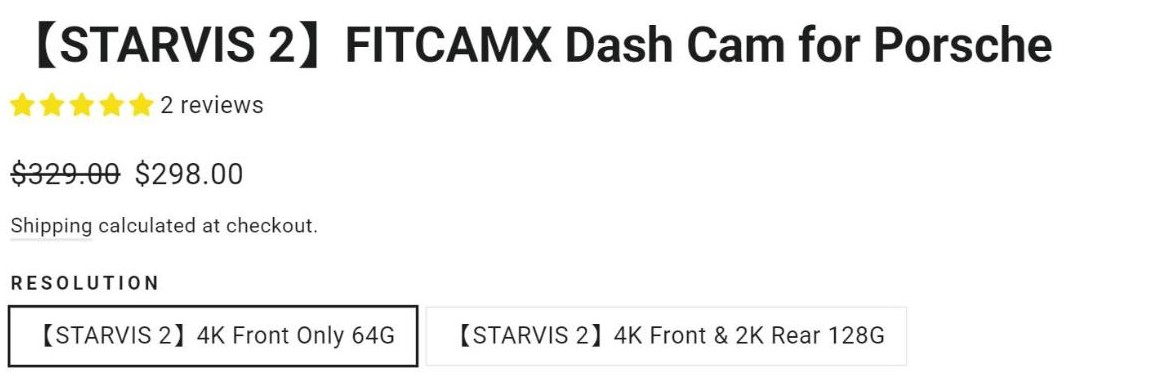
The STARVIS 2 Porsche listing opens at $298 (screenshot from fitcamx.com)
For Porsche, the two listings line up like this:
| Listing | Front only | Dual camera |
|---|---|---|
| Standard 4K | $198 (4K front, 64GB) | $228 (1440P front + 1080P rear, 64GB) / $278 (4K front + 1080P rear, 128GB) |
| STARVIS 2 | $298 (4K front, 64GB) | $378 (4K front + 2K rear, 128GB) |
Two things fall out of that FITCAMX dash cam specs comparison. The first is the size of the step: $100 at the front-only tier and $100 again at the dual-camera tier. The second is that the STARVIS 2 listing does not repeat the compromise described earlier – its dual-camera option keeps the front at 4K and raises the rear from 1080P to 2K. The front-resolution trade in the standard FITCAMX dash cam specs exists only on the standard line.
One caveat on the evidence: the standard Porsche listing shows 103 reviews, the STARVIS 2 listing shows 2. That is a comment on how new the second line is, not on how it performs, and nothing on the page lets a reader conclude more than that.
How the price ladder behaves across different cars
The Toyota and Porsche pages start from different base prices, which is expected for a vehicle-specific module. What is less expected is how regular the sale ladder across the FITCAMX dash cam specs turns out to be.
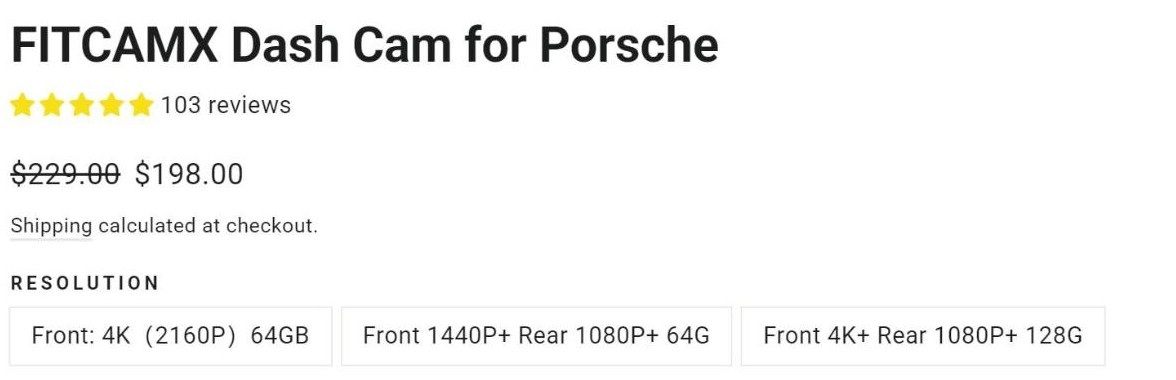
The Porsche listing opens at $198 for the 4K front-only configuration (screenshot from fitcamx.com)
| Page | Entry | Mid | Top | Steps |
|---|---|---|---|---|
| Toyota | $168 | $198 | $248 | +$30, +$50 |
| Porsche | $198 | $228 | $278 | +$30, +$50 |
The sale prices step by exactly the same amounts on both pages, which makes the configuration upgrade cost predictable whatever you drive. The struck-through list prices do not behave the same way: Toyota shows $189 / $229 / $288 while Porsche shows $229 / $299 / $348. Run the arithmetic and the advertised discount is 11.1%, 13.5% and 13.9% on the Toyota page but 13.5%, 23.7% and 20.1% on the Porsche page. The company does not explain the difference, and this review does not guess at one – it is simply a number a reader can check in under a minute.
App, languages and day-to-day use
Across all three columns the FITCAMX dash cam specs list a 2.4GHz WiFi link and an app for both Apple iOS and Android. The page lists fifteen app languages: English, Chinese, Japanese, Russian, Ukrainian, German, Italian, Spanish, French, Korean, Thai, Turkish, Polish, Czech and Hungarian. That is a wider spread than the catalogue’s vehicle coverage would suggest, and it is a practical detail for anyone outside the usual English-first markets.
The WiFi line in the FITCAMX dash cam specs matters more on this kind of camera than on a windscreen unit, because there is no screen on the module. Everything you do after installation – reviewing clips, pulling an incident file off the card, changing settings – happens through the phone over that 2.4GHz link.
Who the FITCAMX dash cam specs suit
A good fit if: you want a dash cam that is invisible from the driver’s seat and leaves no cable hanging down the windscreen; your car is on the fitment list; and you are happy to choose a configuration once and live with it. For that buyer the vehicle-specific design is the whole point, and the published FITCAMX dash cam specs deliver a tidy, factory-looking install.
Worth a second thought if: you move the camera between cars, you want 4K at 60 frames per second, or you want to start with a single camera and add a rear one next year. The page is explicit that the rear camera cannot be added separately, and the 30 FPS row applies to every configuration. Check your model on the FITCAMX fitment list before anything else, because the fitment entry is what determines whether the module clips in at all.
Numbers in the FITCAMX dash cam specs that do not line up
Three points in the FITCAMX dash cam specs are worth recording neutrally, because a reader can verify each one on the same pages this review used.
- Plug and play versus hardwired. The headline section promises “Real Plug and Play” while the spec table requires hardwired installation for parking mode and a hard-wired run from the front camera for the rear module. Both statements are accurate within their own scope; they simply describe different parts of the install.
- A middle tier that is not strictly better. The $198 configuration costs more than the $168 one and records a lower front resolution. The option name says so, but the price order invites the opposite assumption.
- An uneven discount. The sale steps are identical across car pages while the list prices are not, so the advertised percentage saved differs from page to page on the same three configurations.
None of these are errors, and none of them are reasons to avoid the brand. They are the sort of detail that only shows up when you read the specification table against the sales copy, which is the main thing this review set out to do.
How this review was done, in full
Every figure above comes from FITCAMX’s own product pages, read in a browser on 26 October 2026 with the store switched to US dollars. The configuration prices were obtained by selecting each option in turn and reading the price block that the page rendered. The FITCAMX dash cam specs table was read from the product description, not from a press release. Screenshots in this article are unretouched captures of those pages.
What this review is not: a road test. Nobody here fitted a module, drove with it or pulled footage off a card. Where the company makes a performance claim, it is reported as the company’s claim. Prices move, and the FITCAMX dash cam specs for your particular car should be confirmed on the page for that car before you buy. Open the FITCAMX store to check the current figures.
The short version
FITCAMX publishes an unusually clear set of FITCAMX dash cam specs for a dash cam brand, and the clarity works in the buyer’s favour: the configuration names tell you what you are giving up, the parking mode row tells you what you still have to wire, and the fitment list tells you whether the product is for your car at all. The things that count against it are structural rather than hidden – a locked configuration, 30 FPS at 4K, and a rear camera that has to be chosen on day one.
Read as a whole, the FITCAMX dash cam specs describe a camera that is designed around the car rather than around the windscreen, and the range is priced in steps that are easy to follow once you know what each tier contains. See the current FITCAMX range and prices here.
Overall: 8.5 / 10.
Prices, configurations and specifications were read from fitcamx.com on 26 October 2026 with the store set to US dollars and may change without notice. This article contains affiliate links.