

How this review was done. This is a desk review. We did not buy the device, activate it or measure throughput on a trip. Everything below is read from GlobLinker’s own public pages on 23 October 2026 – the product listings, the Supported Countries page, the FAQ blocks and the published policies – and every number is attributed to the page it came from. Where two of the company’s own pages state a figure differently, both versions are printed here rather than averaged.
GlobLinker sells a travel internet device that skips the SIM card entirely. The company calls the technology CloudSIM: instead of holding one carrier’s plastic chip, the GlobLinker CloudSIM hotspot scans the carriers available where it switches on and attaches to the strongest 4G LTE signal it finds. For a traveller, the practical promise of GlobLinker CloudSIM is that a device bought in one country keeps working in the next one without a shop visit, an unlock code or a roaming bill from the operator back home.
That promise is worth reading closely, because the detail lives in the company’s FAQ blocks rather than the headline copy. This review walks through what GlobLinker CloudSIM is, which networks it leans on, what the hardware will and will not do, what the data costs once the free allowance runs out, and two places where GlobLinker’s own pages publish the same fact two different ways. The GlobLinker store is the reference for every figure quoted.
What GlobLinker CloudSIM is, and what it replaces
The product on sale is a pocket hotspot – the GlobLinker AI CloudSIM Portable WiFi Hotspot – listed at 165.00 USD against a 275.00 USD list price, a 40 percent discount that matches the banner running across the site. It is one of only two products GlobLinker sells; the other is a travel adapter covered further down.
What GlobLinker CloudSIM replaces is the sequence most travellers already know: buy a local SIM at the airport, or switch on roaming and accept the home carrier’s per-day fee, or hunt for hotel WiFi. The device creates its own WiFi network out of cellular data, so, as the FAQ puts it, it does not need an existing WiFi connection to get online. GlobLinker CloudSIM is a router, not a phone – there is no voice service and no number.
The second thing GlobLinker CloudSIM replaces is the SIM tray itself. GlobLinker’s FAQ states plainly that no SIM card is needed, because the CloudSIM layer scans carriers and connects without physical hardware changing hands. That is the structural difference from a travel eSIM, where the traveller still picks a plan per country before arriving.
How GlobLinker CloudSIM chooses a network
GlobLinker describes GlobLinker CloudSIM network selection as automatic and signal-led. Its own wording: GlobLinker uses CloudSIM AI technology to scan all carriers, pick the strongest signal, and connect to it instantly. On the coverage page the same idea is phrased as connecting you to the strongest 4G LTE signal across the US and 130 plus countries without multiple SIMs.
Two things follow from that description, and both are worth a traveller’s attention. The first is that GlobLinker CloudSIM is a 4G LTE product by the company’s own account. Nowhere on the public pages is 5G claimed, and no throughput figure – no megabits per second, no fair-use ceiling after which speed drops – is published at all. The second is that the choice of carrier is not the buyer’s. There is no published way to pin GlobLinker CloudSIM to a preferred network, which is the trade a device like this makes in exchange for working everywhere without configuration.
For readers who want the vendor-neutral version of how a device attaches to a visited mobile network, the GSMA’s overview of mobile network technology sets out the generations and the roaming relationships that sit underneath any product of this kind.
The three US carriers behind GlobLinker CloudSIM
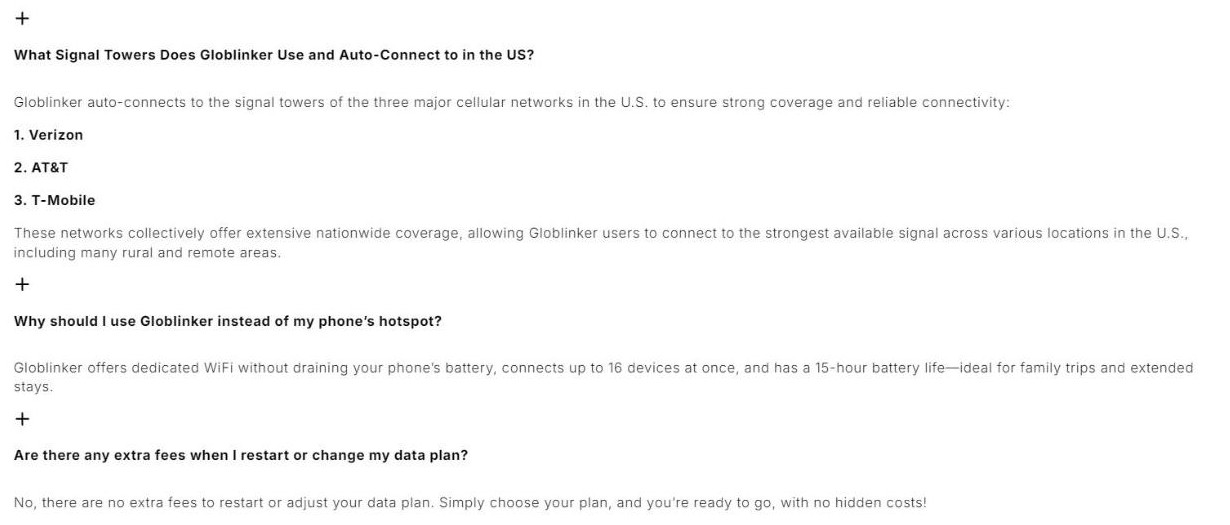
GlobLinker names its three US networks in its own FAQ (screenshot from globlinker.com).
On the Supported Countries page GlobLinker does something most travel-connectivity vendors avoid: it names the networks behind GlobLinker CloudSIM. The FAQ headed “What Signal Towers Does Globlinker Use and Auto-Connect to in the US?” lists Verizon, AT and T and T-Mobile, and says the three collectively offer extensive nationwide coverage, allowing users to connect to the strongest available signal including many rural and remote areas.
That is a useful, checkable statement, and it sets a clear expectation for domestic US use: if all three of those networks are weak at a particular spot, GlobLinker CloudSIM will be weak there too. It is a roaming device, not a satellite one.
What GlobLinker does not publish for GlobLinker CloudSIM is the equivalent list for anywhere else. The site names 130 plus countries but no partner carrier per country outside the United States, so a buyer travelling to, say, rural Portugal cannot check in advance which network GlobLinker CloudSIM will land on. That is a gap in the public information rather than a defect in the product, and it is the single biggest thing a buyer cannot verify before purchase.
Finding one: the device limit is published two different ways
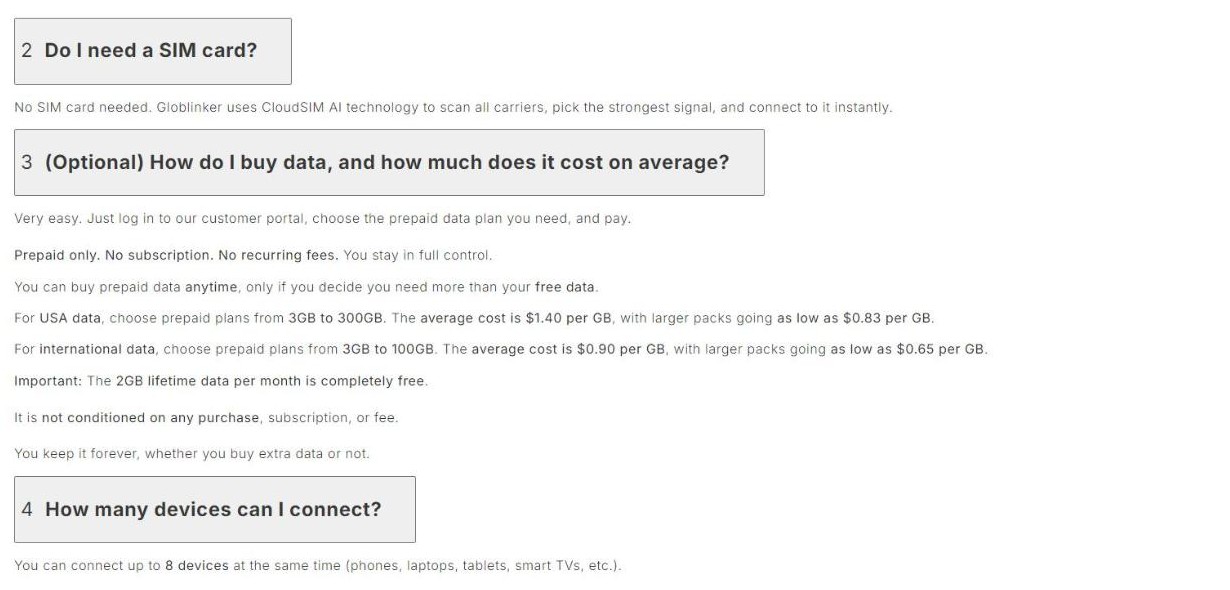
The hotspot product page: no SIM card, prepaid-only data, and a stated limit of 8 devices (screenshot from globlinker.com).
Question 4 on the GlobLinker CloudSIM product page answers “How many devices can I connect?” with: you can connect up to 8 devices at the same time, listing phones, laptops, tablets and smart TVs.
The FAQ on the Supported Countries page answers a differently worded question – why use GlobLinker instead of a phone hotspot – and says GlobLinker CloudSIM connects up to 16 devices at once, alongside the 15-hour battery claim.
Eight and sixteen are both GlobLinker’s numbers, published on GlobLinker’s own site, and nothing on either page reconciles them. A buyer planning around a family of four has no practical problem either way; a buyer planning to put a whole tour group on one hotspot should write to support and get the number in writing before paying. This review does not pick a side between the two figures, and anyone can confirm both in about two minutes by opening the product page and the coverage page side by side.
What GlobLinker CloudSIM costs, and what arrives free
The purchase price is the GlobLinker CloudSIM hotspot itself. On top of that, GlobLinker includes a data allowance that is unusual enough to spell out exactly as the company states it: every device includes 10GB of free starter data, and 2GB of free data every month for life, which the product page says stacks forever.
The FAQ reinforces the condition – or rather the absence of one. In GlobLinker’s words, the 2GB lifetime data per month is completely free, it is not conditioned on any purchase, subscription or fee, and the buyer keeps it whether or not extra data is ever bought. There is no subscription attached to GlobLinker CloudSIM, and no recurring charge appears anywhere in the published pricing.
One caveat the company does flag itself: free data used abroad is converted for international use based on local data costs, so 2GB at home and 2GB on the road are not necessarily the same quantity of browsing. The exact conversion is not published. Current pricing is on the GlobLinker product page.
Prepaid data on top of the GlobLinker CloudSIM allowance
When the free GlobLinker CloudSIM allowance runs out, more data is bought prepaid through the customer portal. GlobLinker’s FAQ is explicit that this is prepaid only, with no subscription and no recurring fees, and that buying more is optional. The published pack ranges and average prices are these:
| Data pool | Pack range | Average cost | Best published rate |
| United States | 3GB to 300GB | 1.40 USD per GB | 0.83 USD per GB |
| International | 3GB to 100GB | 0.90 USD per GB | 0.65 USD per GB |
A separate line in the same FAQ confirms the operational point that matters more than the rate for most travellers: there are no extra fees to restart or adjust a data plan. A GlobLinker CloudSIM device left in a drawer for six months does not need reactivating at a cost, which is a meaningful difference from a prepaid SIM that expires if unused.
One number the company does not publish is an expiry date for purchased packs. The product page says the free monthly allowance never expires; the general prepaid language in the Terms refers to data being used until it is depleted or expires. Those are two different buckets of data and no explicit expiry window for the paid packs appears in public. Worth an email before buying a 300GB pack.
Finding two: international data is priced below US data
Put the two rows of that table next to each other and something counter-intuitive appears. The international pool averages 0.90 USD per GB against 1.40 USD for the US pool – roughly 36 percent less – and the best published rate is 0.65 USD against 0.83 USD. Everywhere else in travel connectivity, leaving the country is the expensive direction.
There is a fair caveat, and it belongs in the same breath. The US pool runs up to 300GB while the international pool stops at 100GB, so the two averages are taken across different pack ladders and the cheapest US rate is only reachable at volumes the international pool does not sell. For a traveller buying a realistic 10GB or 20GB pack, though, the direction of the gap still favours the trip abroad.
GlobLinker does not draw attention to this anywhere in its marketing copy – the numbers simply sit in an optional FAQ halfway down the product page. It is the sort of thing a buyer can verify in a minute and then use: if the device is being bought mainly for one big overseas trip, the running cost argument for GlobLinker CloudSIM is stronger than the domestic one.
Battery, coverage and the hardware limits
The published GlobLinker CloudSIM hardware claims are short enough to list in full. Battery life is given as up to 15 hours. Coverage is given as 130 plus countries. The connection is 4G LTE. The device needs no SIM and no existing WiFi. Beyond that, GlobLinker publishes no weight, no dimensions, no supported LTE bands, no charging standard and no simultaneous-throughput figure.
The band question is the one a frequent traveller would want answered, because LTE band support is what determines whether a device that works in Europe also works well in Japan or Brazil. GlobLinker’s answer is implicit rather than explicit: it points at the country list instead. For most buyers the country list is the practical test, and it is worth opening before purchase because it mixes sovereign countries with territories – Hong Kong, Macau, Puerto Rico, Guam, Gibraltar, the Canary Islands and Hawaii all appear as separate entries, and at least one entry is marked as coming soon rather than live.
Charging the GlobLinker CloudSIM hotspot is a travel problem of its own, which is where GlobLinker’s second product comes in.
The travel kit sold beside GlobLinker CloudSIM
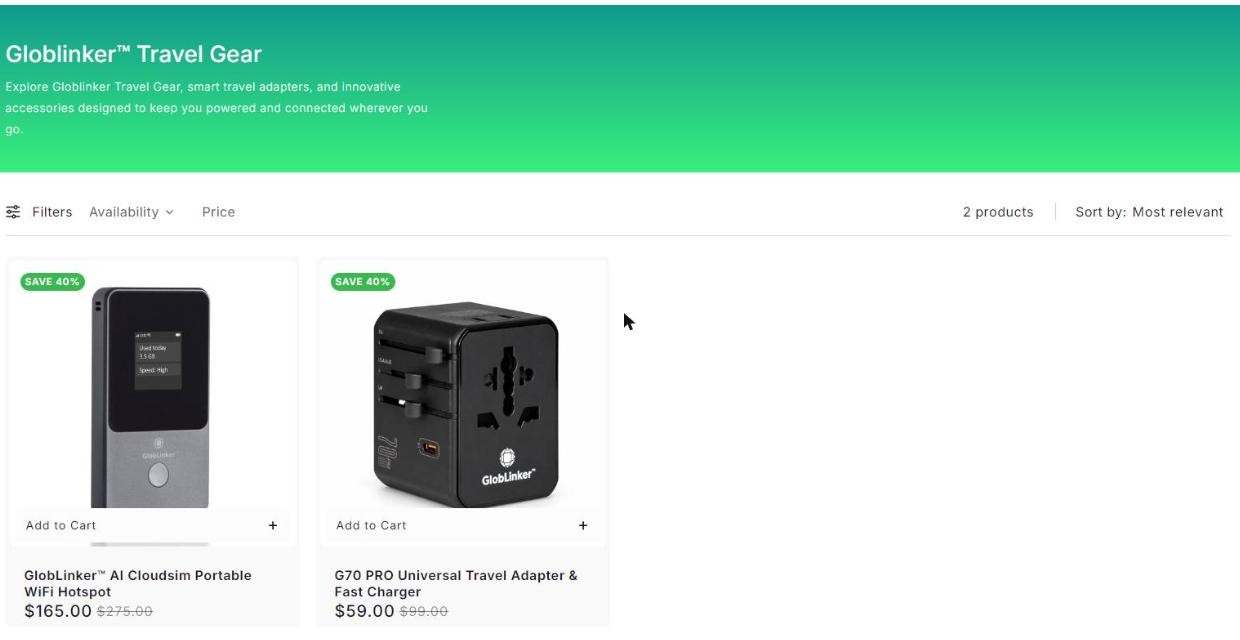
GlobLinker sells exactly two products: the hotspot and the adapter (screenshot from globlinker.com).
The Travel Gear collection holds two items, no more. Alongside the GlobLinker CloudSIM hotspot sits the G70 PRO Universal Travel Adapter and Fast Charger at 59.00 USD against a 99.00 USD list price. The pairing is deliberate: a GlobLinker CloudSIM hotspot that runs 15 hours needs charging every night, and a traveller crossing plug standards needs an adapter anyway.
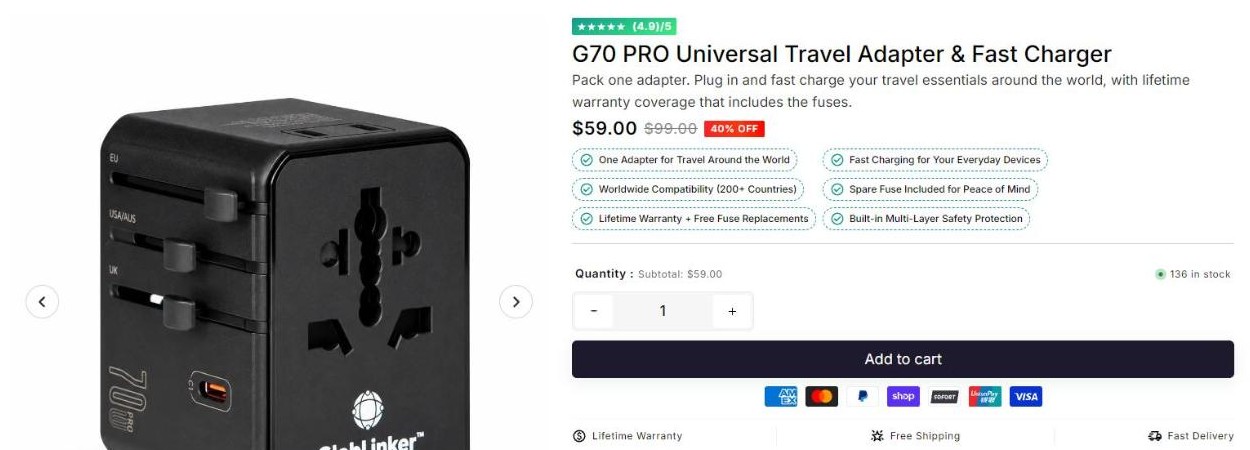
The G70 PRO product page (screenshot from globlinker.com).
The published specification is 70W GaN charging across five ports – three USB-C and two USB-A – with US, UK, EU and AU plug positions built in, a replaceable 10A fuse with a spare included in the box, Smart IC power allocation, and what the company calls a lifetime warranty that includes free fuse replacements. Its own FAQ confirms it can charge the GlobLinker CloudSIM hotspot. Both products sit in the same small catalogue.
What the G70 PRO does not do
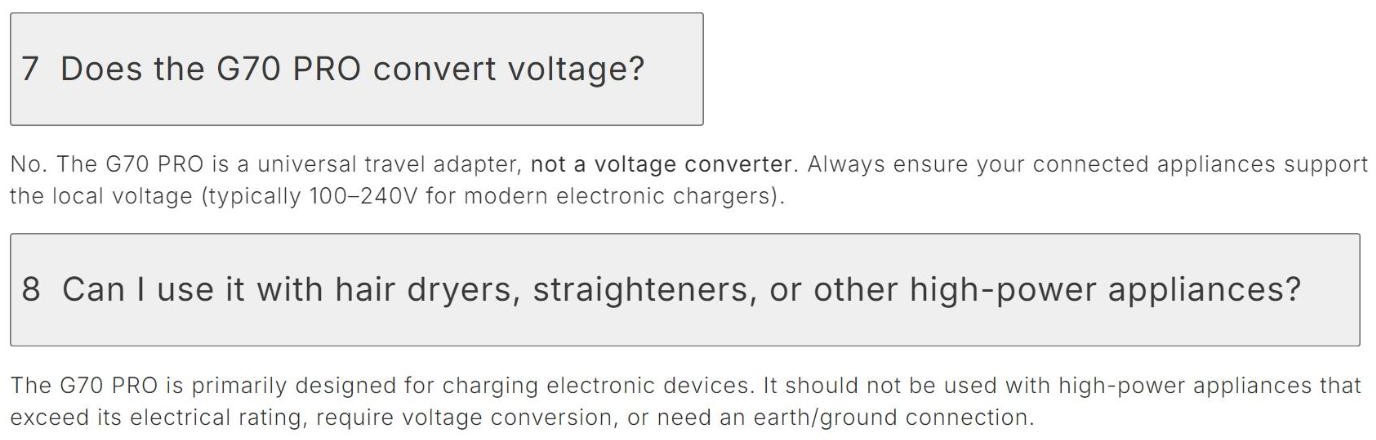
The adapter FAQ is explicit about voltage (screenshot from globlinker.com).
This is the clearest piece of writing on the whole site, and it deserves repeating because getting it wrong destroys appliances. Question 7 asks whether the G70 PRO converts voltage. The answer: no, the G70 PRO is a universal travel adapter, not a voltage converter, and the buyer should always ensure connected appliances support the local voltage, typically 100 to 240V for modern electronic chargers.
Question 8 follows it up for the appliance most often ruined this way. The G70 PRO is primarily designed for charging electronic devices, and should not be used with high-power appliances that exceed its electrical rating, require voltage conversion, or need an earth or ground connection. Hair dryers and straighteners are named in the question itself.
In practice that means the adapter is right for the things a GlobLinker CloudSIM traveller actually carries – phone, laptop, tablet, camera battery, the hotspot itself – and wrong for anything with a heating element. A vendor spelling that out in its own FAQ, rather than burying it in a manual, is a point in its favour.
Shipping, duties and returns
Three GlobLinker CloudSIM policy points are worth lifting out of the published terms because they change the real cost of ownership. Shipping is free on all orders, with handling of one to two days and delivery quoted at four to seven business days inside the US and six to eight internationally.
The duties clause is the unusual one. GlobLinker’s terms state that the company covers all taxes, customs and import fees to every destination. For a buyer outside the United States that removes the single largest hidden cost of ordering hardware from an overseas store, and it is the kind of commitment that is easy to check against the invoice when the parcel lands.
Returns run 60 days from receipt, return shipping is free, and – the detail most stores do not offer – an activated and used device can still be returned, with refunds processed in one to two business days. The exclusion is prepaid data, which is not refundable. GlobLinker CloudSIM carries a limited lifetime warranty whose terms allow repair or replacement with a new or refurbished unit at the company’s option, which is worth noting because the sales page phrases the same promise as a free brand-new replacement.
Who GlobLinker CloudSIM suits, and who it does not
GlobLinker CloudSIM suits a traveller who crosses several countries on one trip and does not want to think about connectivity in any of them: one device, one charge, no SIM shop, no roaming toggle. It suits a family or a small group sharing one connection, which is where the free monthly allowance and the lack of a subscription do real work. It suits anyone who travels a few times a year rather than monthly, because a GlobLinker CloudSIM device that costs nothing to leave dormant is a different proposition from a plan that lapses.
It suits people in rural US areas less obviously than the marketing suggests, but still plausibly, since it draws on all three major carriers rather than one.
It is a weaker fit for someone who needs a guaranteed speed, because none is published; for someone who needs 5G specifically, because the published claim is 4G LTE; for a single traveller staying in one country for a month, where a local SIM or a single-country eSIM will usually cost less; and for anyone who needs to know the partner carrier in a specific foreign city before committing, because GlobLinker CloudSIM does not publish that list.
How this review of GlobLinker CloudSIM was done
Every figure above about GlobLinker CloudSIM was read from GlobLinker’s own published pages on 23 October 2026: the two product listings, the Travel Gear collection, the Supported Countries page with its FAQ block, the product-page FAQ accordions, and the shipping, returns and terms pages. Prices were read with the store set to US dollars.
No device was purchased, activated or speed-tested, and no claim here about real-world performance is made on our own authority – where the text says the device does something, it means the company states that it does. The two contradictions in section four and section seven were found by comparing GlobLinker pages against each other, and both are reproducible by any reader with a browser. The screenshots are unedited captures of those pages, cropped only to remove navigation furniture and customer photographs.
The short version
GlobLinker sells GlobLinker CloudSIM, a SIM-free travel hotspot, at 165.00 USD with 10GB of starter data and 2GB free every month for life, no subscription, free shipping, duties covered, 60 days to return it even after use, and prepaid top-ups that are cheaper internationally than domestically. It names its three US carriers in public, which few competitors do, and it is honest in its own FAQ about what its adapter will not do.
Against that, the published specification is thin – 4G LTE, 15 hours, 130 plus countries and little else – the device limit appears as both 8 and 16 on the company’s own pages, no partner carrier is named outside the United States, and no expiry is published for paid data packs. None of those is disqualifying; all of them are questions worth sending to support before a large purchase.
Overall: 8.4 / 10. A clearly priced, clearly documented travel device whose unusual terms – lifetime free monthly data, duties paid, returns accepted after activation – are better than the category norm, held back from a higher score by published specifications that stop short of what a frequent traveller would want to check. Current pricing and stock are on the GlobLinker store.